

Officially known as AIAA Rutgers Rocket Propulsion Laboratory, Rutgers RPL as an entire organization is divided into two separate divisions. First, there is the Engineering Division, and second, the Business & Operations Division. The Engineering Division is divided into six separate engineering sub-teams: Telemetry, Propulsion, Aero-body, Recovery, Payload, and Simulations. In this post, we will be focusing on introducing the Propulsion sub-team and you’ll get to know a little bit of what we have been doing lately.
Enjoy!
Currently, the team consists of roughly nine undergraduate engineering students that are working on developing a Crawford Strand Burner. An apparatus that will be simulating the conditions of a solid propellant motor’s combustion chamber. It will help to characterize the experimental solid propellant by determining the propellant’s burn rate. Why is the burn rate important? The answer is very technical and convoluted but a good answer can still be given by assuming basic physics education.

The burn rate (B) of a solid propellant is governed by three parameters. The burn rate coefficient (a), the burn rate exponent (n) and the chamber pressure (P) of the strand burner during tests. The first two parameters are obtained through regression analysis by assuming that the burn rate equation is an exponential function.

The equation is inherently empirical and at best a proportional relation and not a direct equivalent, mostly due to the unsteady phenomena of combustion. Once the burn rate equation is obtained for multiple chamber pressure values, the function is plugged into the mass flow rate equation of the solid propellant during combustion. The mass flow rate can then help determine the exhaust velocity of the solid motor which ultimately determines the contour of the solid motor nozzle. Neat stuff right? The Crawford Strand Burner ultimately helps us (the Propulsion sub-team) design beautiful solid motor nozzles.
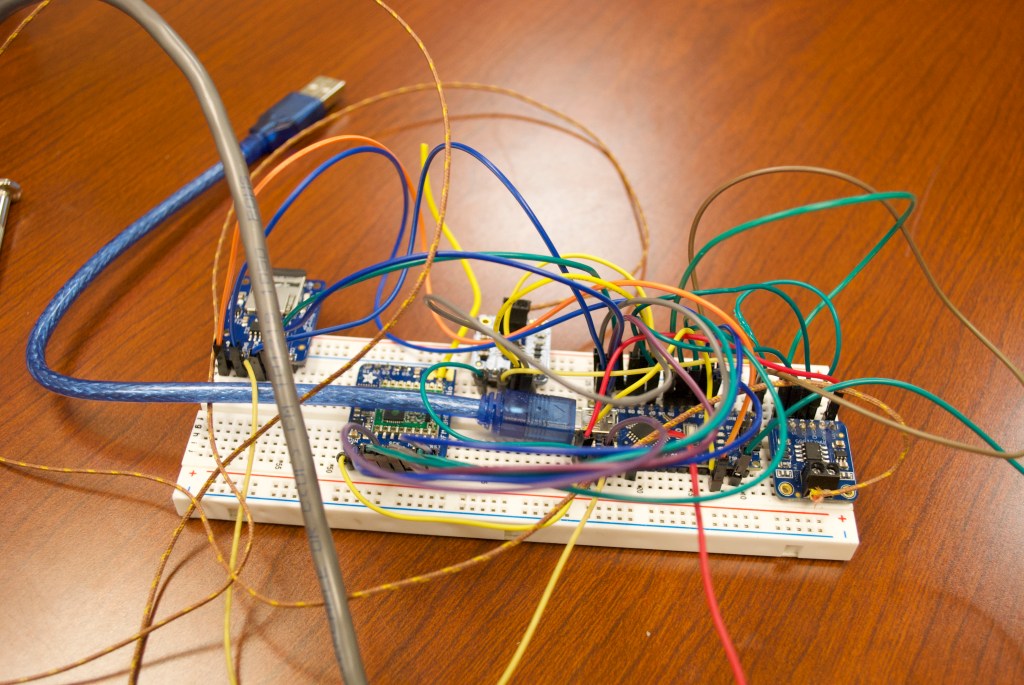
While the theory is solid and well understood, manufacturing of the apparatus is another story and the main sink of all of our efforts. The electronics that will be acquiring data and controlling the strand burner remotely, are almost completely integrated and the simulations of our pressure vessel (the hollow piece of the strand burner AKA where the tests will be taking place) has recently been finished.

I hope you enjoyed this post and that you might have learned a thing or two! We’ll be sure to keep you updated once the design of the strand burner is completely finished and manufacturing is well on its way. Stay tuned!
– Edwin Guerrero
VP & Propulsion Lead of AIAA RRPL

 Rutgers RPL